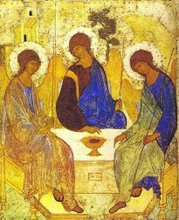
257 "O blessed light, O Trinity and first Unity!" God is eternal blessedness, undying life, unfading light. God is love: Father, Son and Holy Spirit. God freely wills to communicate the glory of his blessed life. Such is the "plan of his loving kindness", conceived by the Father before the foundation of the world, in his beloved Son: "He destined us in love to be his sons" and "to be conformed to the image of his Son", through "the spirit of sonship". This plan is a "grace [which] was given to us in Christ Jesus before the ages began", stemming immediately from Trinitarian love. It unfolds in the work of creation, the whole history of salvation after the fall, and the missions of the Son and the Spirit, which are continued in the mission of the Church.
813 The Church is one because of her source: "the highest exemplar and source of this mystery is the unity, in the Trinity of Persons, of one God, the Father and the Son in the Holy Spirit." The Church is one because of her founder: for "the Word made flesh, the prince of peace, reconciled all men to God by the cross, . . . restoring the unity of all in one people and one body." The Church is one because of her "soul": "It is the Holy Spirit, dwelling in those who believe and pervading and ruling over the entire Church, who brings about that wonderful communion of the faithful and joins them together so intimately in Christ that he is the principle of the Church's unity." Unity is of the essence of the Church:
What an astonishing mystery! There is one Father of the universe, one Logos of the universe, and also one Holy Spirit, everywhere one and the same; there is also one virgin become mother, and I should like to call her "Church."
260 The ultimate end of the whole divine economy is the entry of God's creatures into the perfect unity of the Blessed Trinity. But even now we are called to be a dwelling for the Most Holy Trinity: "If a man loves me", says the Lord, "he will keep my word, and my Father will love him, and we will come to him, and make our home with him":
O my God, Trinity whom I adore, help me forget myself entirely so to establish myself in you, unmovable and peaceful as if my soul were already in eternity. May nothing be able to trouble my peace or make me leave you, O my unchanging God, but may each minute bring me more deeply into your mystery! Grant my soul peace. Make it your heaven, your beloved dwelling and the place of your rest. May I never abandon you there, but may I be there, whole and entire, completely vigilant in my faith, entirely adoring, and wholly given over to your creative action.
266 "Now this is the Catholic faith: We worship one God in the Trinity and the Trinity in unity, without either confusing the persons or dividing the substance; for the person of the Father is one, the Son's is another, the Holy Spirit's another; but the Godhead of the Father, Son and Holy Spirit is one, their glory equal, their majesty coeternal" (Athanasian Creed: DS 75; ND 16).
256 St. Gregory of Nazianzus, also called "the Theologian", entrusts this summary of Trinitarian faith to the catechumens of Constantinople:
Above all guard for me this great deposit of faith for which I live and fight, which I want to take with me as a companion, and which makes me bear all evils and despise all pleasures: I mean the profession of faith in the Father and the Son and the Holy Spirit. I entrust it to you today. By it I am soon going to plunge you into water and raise you up from it. I give it to you as the companion and patron of your whole life. I give you but one divinity and power, existing one in three, and containing the three in a distinct way. Divinity without disparity of substance or nature, without superior degree that raises up or inferior degree that casts down. . . the infinite co-naturality of three infinites. Each person considered in himself is entirely God. . . the three considered together. . . I have not even begun to think of unity when the Trinity bathes me in its splendor. I have not even begun to think of the Trinity when unity grasps me. . .
2845 There is no limit or measure to this essentially divine forgiveness, whether one speaks of "sins" as in Luke (11:4), "debts" as in Matthew (6:12). We are always debtors: "Owe no one anything, except to love one another." The communion of the Holy Trinity is the source and criterion of truth in every relation ship. It is lived out in prayer, above all in the Eucharist.
God does not accept the sacrifice of a sower of disunion, but commands that he depart from the altar so that he may first be reconciled with his brother. For God can be appeased only by prayers that make peace. To God, the better offering is peace, brotherly concord, and a people made one in the unity of the Father, Son, and Holy Spirit.
738 Thus the Church's mission is not an addition to that of Christ and the Holy Spirit, but is its sacrament: in her whole being and in all her members, the Church is sent to announce, bear witness, make present, and spread the mystery of the communion of the Holy Trinity (the topic of the next article):
All of us who have received one and the same Spirit, that is, the Holy Spirit, are in a sense blended together with one another and with God. For if Christ, together with the Father's and his own Spirit, comes to dwell in each of us, though we are many, still the Spirit is one and undivided. He binds together the spirits of each and every one of us, . . . and makes all appear as one in him. For just as the power of Christ's sacred flesh unites those in whom it dwells into one body, I think that in the same way the one and undivided Spirit of God, who dwells in all, leads all into spiritual unity.

Showing posts with label the Holy Spirit. Show all posts
Showing posts with label the Holy Spirit. Show all posts
Sunday, June 7, 2009

Friday, July 25, 2008
The Most Holy Trinity: a Union of Love
It is said that a people's values can be seen in the god they worship. For Christians, ``God is love'' (1 Jn 4:8). But a God who is love seems like a philosophical impossibility. How can one God, who is perfect, lacking nothing in himself and possessed of no dependence on creatures, be love when love necessitates a relation to another?
The resolution of this paradox God himself has revealed to us: God is perfect unity, but a unity of three Divine Persons-- Father, Son, and Holy Spirit-- who are each equally divine. The Father, Son, and Spirit exist from all eternity. None precedes the other in time, but each are related to the others by a relationship that orders them with respect to the others.
The ever-living, all-knowing, almighty God the Father exists from all eternity and is the source of all perfection created and uncreated. The self-conception and self-expression of the perfect Being is so complete that it is another person: God the Son, the image of the invisible Father, ``the only-begotten Son of God, begotten from the Father before all the ages, light from light, true God from true God, begotten not made, consubstantial with the Father, through whom all things came to be'' (Nicene-Constantipolitan Creed). The love between the Father and the Son is so perfect that it too is another person: the Holy Spirit ``the holy, the lordly and life-giving one, proceeding forth from the Father [and the Son], co-worshipped and co-glorified with Father and Son'' (ibid.).
But if the Holy Spirit is the love between the Father and the Son, how can God as a whole be called Love? Each person shares equally in the divine nature, so that each person shares equally in the perfections of the others. The only distinction between the persons of the Trinity is their mutual relations. None of the persons exists in respect to himself alone, but each exists relatively to the other two:
...the ``three persons'' who exist in God are the reality of word and love in their attachment to each other. They are not substances, personalities in the modern sense, but the relatedness whose pure actuality... does not impair unity of the highest being but fills it out. St Augustine once enshrined this idea in the following formula: ``He is not called Father with reference to himself but only in relation to the Son; seen by himself he is simply God.'' Here the decisive point comes beautifully to light. ``Father'' is purely a concept of relationship. Only in being-for the other is he Father; in his own being-in-himself he is simply God. Person is the pure relation of being related, nothing else. Relationship is not something extra added to the person, as it is with us; it only exists at all as relatedness.
....the First Person [the Father] does not beget the Son in the sense of the act of begetting coming on top of the finished Person; it is the act of begetting, of giving oneself, of streaming forth. It is identical with the act of giving. (Joseph Ratzinger Introduction to Christianity, pp. 131-132; cf. Augustine, Enarationes in Psalmos 68; De Trinitate VII, 1, 2.) Each of the persons of the Trinity lives completely for the others; each is a complete gift of self to the others. The complete self-giving not only constitutes the individual persons of the Trinity, but also their inseparable oneness.
Thus, for Christians the very basis of all reality is the loving communion of persons that is the Holy Trinity.
- Augustine Club@columbia.edu
The resolution of this paradox God himself has revealed to us: God is perfect unity, but a unity of three Divine Persons-- Father, Son, and Holy Spirit-- who are each equally divine. The Father, Son, and Spirit exist from all eternity. None precedes the other in time, but each are related to the others by a relationship that orders them with respect to the others.
The ever-living, all-knowing, almighty God the Father exists from all eternity and is the source of all perfection created and uncreated. The self-conception and self-expression of the perfect Being is so complete that it is another person: God the Son, the image of the invisible Father, ``the only-begotten Son of God, begotten from the Father before all the ages, light from light, true God from true God, begotten not made, consubstantial with the Father, through whom all things came to be'' (Nicene-Constantipolitan Creed). The love between the Father and the Son is so perfect that it too is another person: the Holy Spirit ``the holy, the lordly and life-giving one, proceeding forth from the Father [and the Son], co-worshipped and co-glorified with Father and Son'' (ibid.).
But if the Holy Spirit is the love between the Father and the Son, how can God as a whole be called Love? Each person shares equally in the divine nature, so that each person shares equally in the perfections of the others. The only distinction between the persons of the Trinity is their mutual relations. None of the persons exists in respect to himself alone, but each exists relatively to the other two:
...the ``three persons'' who exist in God are the reality of word and love in their attachment to each other. They are not substances, personalities in the modern sense, but the relatedness whose pure actuality... does not impair unity of the highest being but fills it out. St Augustine once enshrined this idea in the following formula: ``He is not called Father with reference to himself but only in relation to the Son; seen by himself he is simply God.'' Here the decisive point comes beautifully to light. ``Father'' is purely a concept of relationship. Only in being-for the other is he Father; in his own being-in-himself he is simply God. Person is the pure relation of being related, nothing else. Relationship is not something extra added to the person, as it is with us; it only exists at all as relatedness.
....the First Person [the Father] does not beget the Son in the sense of the act of begetting coming on top of the finished Person; it is the act of begetting, of giving oneself, of streaming forth. It is identical with the act of giving. (Joseph Ratzinger Introduction to Christianity, pp. 131-132; cf. Augustine, Enarationes in Psalmos 68; De Trinitate VII, 1, 2.) Each of the persons of the Trinity lives completely for the others; each is a complete gift of self to the others. The complete self-giving not only constitutes the individual persons of the Trinity, but also their inseparable oneness.
Thus, for Christians the very basis of all reality is the loving communion of persons that is the Holy Trinity.
- Augustine Club@columbia.edu
Subscribe to:
Posts (Atom)