I have been pondering on God's love with special focus on the subject of 'gift'.
Now I have some good news to share.
God, in the most basic terms, is internal exchange of self-gift.
This is because God is love. This love is so infinite that it is personal.
So God was revealed as the Blessed Trinity to those who are grown in love.
Here is a progressing way through which I discover this great wonder.
God is:
To Be ->infinitely -> - The Father - the lover
To Love ->infinite -> - The Holy Spirit - the love
To Be Loved ->infinite -> - The Son - the beloved
Note that God is those persons from all eternity, but men take on those at Creation.
When man is created, since all things are created in the Son, he becomes son right from nothingness (or from dust if you will).
Then he is loved, he learns about love as he grows in Holiness (or in the Holy Spirit). This largely depends on his mother as the process of being loved starts at his creation/conception.
Last when he wants to love, he becomes father at an other moment of creation, that is the creation of his child.
This tells me that all human persons are ministries. Our ministry is to image God. We become ministers of what God is always. We BECOME but God IS always.
All this to teach us love which is also an other way of saying 'to teach us God'.
All this we received as gifts.
God gave us gifts to introduce himself who is the final gift.
How can you be a gift to someone who does not even exist?
You create him as a person for only a person can understand what a gift is.
But even for a person to understand it, he must be used to receiving gifts.
So you send gifts before you.
God surrounds us with gifts and through them we slowly get ready for him.
So slowly we learn to receive what God himself is for all eternity.
At the end when we are fully tuned to the template, it will be Heaven.
God is himself Heaven.
When we are perfectly in him, it will be perfectly in Heaven.
God bless!

Showing posts with label Holy Trinity. Show all posts
Showing posts with label Holy Trinity. Show all posts
Saturday, February 5, 2011

Friday, July 25, 2008
The Most Holy Trinity: a Union of Love
It is said that a people's values can be seen in the god they worship. For Christians, ``God is love'' (1 Jn 4:8). But a God who is love seems like a philosophical impossibility. How can one God, who is perfect, lacking nothing in himself and possessed of no dependence on creatures, be love when love necessitates a relation to another?
The resolution of this paradox God himself has revealed to us: God is perfect unity, but a unity of three Divine Persons-- Father, Son, and Holy Spirit-- who are each equally divine. The Father, Son, and Spirit exist from all eternity. None precedes the other in time, but each are related to the others by a relationship that orders them with respect to the others.
The ever-living, all-knowing, almighty God the Father exists from all eternity and is the source of all perfection created and uncreated. The self-conception and self-expression of the perfect Being is so complete that it is another person: God the Son, the image of the invisible Father, ``the only-begotten Son of God, begotten from the Father before all the ages, light from light, true God from true God, begotten not made, consubstantial with the Father, through whom all things came to be'' (Nicene-Constantipolitan Creed). The love between the Father and the Son is so perfect that it too is another person: the Holy Spirit ``the holy, the lordly and life-giving one, proceeding forth from the Father [and the Son], co-worshipped and co-glorified with Father and Son'' (ibid.).
But if the Holy Spirit is the love between the Father and the Son, how can God as a whole be called Love? Each person shares equally in the divine nature, so that each person shares equally in the perfections of the others. The only distinction between the persons of the Trinity is their mutual relations. None of the persons exists in respect to himself alone, but each exists relatively to the other two:
...the ``three persons'' who exist in God are the reality of word and love in their attachment to each other. They are not substances, personalities in the modern sense, but the relatedness whose pure actuality... does not impair unity of the highest being but fills it out. St Augustine once enshrined this idea in the following formula: ``He is not called Father with reference to himself but only in relation to the Son; seen by himself he is simply God.'' Here the decisive point comes beautifully to light. ``Father'' is purely a concept of relationship. Only in being-for the other is he Father; in his own being-in-himself he is simply God. Person is the pure relation of being related, nothing else. Relationship is not something extra added to the person, as it is with us; it only exists at all as relatedness.
....the First Person [the Father] does not beget the Son in the sense of the act of begetting coming on top of the finished Person; it is the act of begetting, of giving oneself, of streaming forth. It is identical with the act of giving. (Joseph Ratzinger Introduction to Christianity, pp. 131-132; cf. Augustine, Enarationes in Psalmos 68; De Trinitate VII, 1, 2.) Each of the persons of the Trinity lives completely for the others; each is a complete gift of self to the others. The complete self-giving not only constitutes the individual persons of the Trinity, but also their inseparable oneness.
Thus, for Christians the very basis of all reality is the loving communion of persons that is the Holy Trinity.
- Augustine Club@columbia.edu
Monday, June 4, 2007
Faith in the Triune God
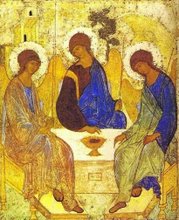
On the occasion of the Feast of Most Holy Trinity I would like to propose this reflection given about the Triune God in 2004. It concludes with a point on Lublev Icon:
God is One and Three: he is not an eternal solitude; rather, he is an
eternal love that is based on the reciprocity of the Persons, a love that is the
first cause, the origin, and the foundation of all being and of every form of
life. Unity engendered by love, trinitarian unity, is a unity infinitely more profound
than the unity of a building stone, indivisible as that may be from a material
perspective.This supreme unity is not rigidly static; it is love. The most
beautiful artistic depiction of this mystery was left to us by Andrei Rublev in
the fifteenth century: the world-renowned icon of the Trinity. Of course, it
does not portray the eternal mystery of God in himself, who would dare to do
that? It attempts, rather, to represent this mystery as it is reflected in the
gift of itself in history, as in the visit of the three men to Abraham by the
oaks of Mamre (Gen 18:1-33). Abraham immediately recognized that they were not
just like any other men, but that God himself was coming to him through them.In
Rublev's icon, the mystery of this event is made visible, presented as an event
that can be contemplated in its many dimensions: thus the mystery as such is
respected. The artistic richness of this icon allows me to underscore another
characteristic: the natural surroundings of this event, which express the
mystery of the Persons. We are near the oaks of Mamre, which Rublev depicts in
stylized form as a single tree representing the tree of life; and this tree of
life is none other than the trinitarian love that created the world, sustains
it, saves it, and is the source of all life. We see also the tent, the dwelling
of Abraham, which recalls the Prologue of John's Gospel: "And the Word became
flesh and dwelt among us" (Jn 1:14).The body of the incarnate Word of God became
itself the tent, the place where God dwells: God becomes our refuge and our
dwelling place. Finally, the gift that Abraham offers, "a calf, tender and
good", is replaced, in the icon, with a cup, a symbol of the Eucharist, a sign
of the gift in which God gives himself: "Love, sacrifice, and self-immolation
preceded the act by which the world was created and are the source of that
creation." [1] The tree, the tent, and the cup: these elements show us the
mystery of God, allow us to immerse ourselves in the contemplation of its
intimate depths, in his trinitarian love. This is the God that we celebrate.
This is the God who gives us joy. He is the true hope of our world. Amen.
Wednesday, May 2, 2007
The Origin of Love

Hmm. It can be a serious problem for a person like me to decide on which should be the first post, on my first blog. So looking at the name, and thinking about what inspired me in the first place to create the blog, I think I should start with a small word about the Catholic Church.
The more I discover my catholic faith, the more I discover that it is itsself at the core of this civilization. I am not saying that people never loved before the Church come to be, or that people who never new about it never knew love. I am referring to the founder of the Church.
Jesus once said that before Abraham was, He is. And we christians take from this statement to nourish our faith in divinity of Jesus Christ. So it is true; all mankind from the beginning knew love. That is because, the Creator God himself is God. This is my faith. This is the faith of the Church. And this notion is best understood by a meditation about the Blessed Trinity. If God is Love, he was Love and loved even before He created anything.
I have heard that God is a community of three divine persons who love each other so much that they are one God. They are actually different in their personalities and yet one in their divine nature, and loving is natural activity as Love is in their essence. This explains the reality well know to us that love can not truly be present without at least three persons. Yes three, not two:). Christians would count at least two persons and God. The third necessary person can be seen as some kind of witness who testify for each of the two lovers. The person who can be the 'advisor', the 'councelor', the 'witness', etc, for each person to always give more and more strength to the relationship.
So, I am discovering that anything that happens in life, and question can be answered by a simple meditation on the above picture created by Andre Rubrev. It explains everything in the human civilization, the History of Salvation, and this Civilization of Love I will be talking about on this blog.
Love is from God and in humanity it starts from marriage! More insight on this article were the icon was taken from.
Subscribe to:
Posts (Atom)