Monday, August 31, 2009
Intro of "Charity in Truth"

Saturday, October 6, 2007
"Walk as children of light" (Eph 5:8): bringing about a transformation of culture
"Walk as children of light" (Eph 5:8): bringing about a transformation of culture
95. "Walk as children of light ... and try to learn what is pleasing to the Lord. Take no part in the unfruitful works of darkness" (Eph 5:8, 10-11). In our present social context, marked by a dramatic struggle between the "culture of life" and the "culture of death", there is need to develop a deep critical sense, capable of discerning true values and authentic needs.
What is urgently called for is a general mobilization of consciences and a united ethical effort to activate a great campaign in support of life. All together, we must build a new culture of life: new, because it will be able to confront and solve today's unprecedented problems affecting human life; new, because it will be adopted with deeper and more dynamic conviction by all Christians; new, because it will be capable of bringing about a serious and courageous cultural dialogue among all parties. While the urgent need for such a cultural transformation is linked to the present historical situation, it is also rooted in the Church's mission of evangelization. The purpose of the Gospel, in fact, is "to transform humanity from within and to make it new".123 Like the yeast which leavens the whole measure of dough (cf. Mt 13:33), the Gospel is meant to permeate all cultures and give them life from within, 124 so that they may express the full truth about the human person and about human life.
We need to begin with the renewal of a culture of life within Christian communities themselves. Too often it happens that believers, even those who take an active part in the life of the Church, end up by separating their Christian faith from its ethical requirements concerning life, and thus fall into moral subjectivism and certain objectionable ways of acting. With great openness and courage, we need to question how widespread is the culture of life today among individual Christians, families, groups and communities in our Dioceses. With equal clarity and determination we must identify the steps we are called to take in order to serve life in all its truth. At the same time, we need to promote a serious and in-depth exchange about basic issues of human life with everyone, including non-believers, in intellectual circles, in the various professional spheres and at the level of people's everyday life.
96. The first and fundamental step towards this cultural transformation consists in forming consciences with regard to the incomparable and inviolable worth of every human life. It is of the greatest importance to re-establish the essential connection between life and freedom. These are inseparable goods: where one is violated, the other also ends up being violated. There is no true freedom where life is not welcomed and loved; and there is no fullness of life except in freedom. Both realities have something inherent and specific which links them inextricably: the vocation to love. Love, as a sincere gift of self, 125 is what gives the life and freedom of the person their truest meaning.
No less critical in the formation of conscience is the recovery of the necessary link between freedom and truth. As I have frequently stated, when freedom is detached from objective truth it becomes impossible to establish personal rights on a firm rational basis; and the ground is laid for society to be at the mercy of the unrestrained will of individuals or the oppressive totalitarianism of public authority. 126
It is therefore essential that man should acknowledge his inherent condition as a creature to whom God has granted being and life as a gift and a duty. Only by admitting his innate dependence can man live and use his freedom to the full, and at the same time respect the life and freedom of every other person. Here especially one sees that "at the heart of every culture lies the attitude man takes to the greatest mystery: the mystery of God".127 Where God is denied and people live as though he did not exist, or his commandments are not taken into account, the dignity of the human person and the inviolability of human life also end up being rejected or compromised.
97. Closely connected with the formation of conscience is the work of education, which helps individuals to be ever more human, leads them ever more fully to the truth, instils in them growing respect for life, and trains them in right interpersonal relationships.
In particular, there is a need for education about the value of life from its very origins. It is an illusion to think that we can build a true culture of human life if we do not help the young to accept and experience sexuality and love and the whole of life according to their true meaning and in their close interconnection. Sexuality, which enriches the whole person, "manifests its inmost meaning in leading the person to the gift of self in love".128 The trivialization of sexuality is among the principal factors which have led to contempt for new life. Only a true love is able to protect life. There can be no avoiding the duty to offer, especially to adolescents and young adults, an authentic education in sexuality and in love, an education which involves training in chastity as a virtue which fosters personal maturity and makes one capable of respecting the "spousal" meaning of the body.
The work of educating in the service of life involves the training of married couples in responsible procreation. In its true meaning, responsible procreation requires couples to be obedient to the Lord's call and to act as faithful interpreters of his plan. This happens when the family is generously open to new lives, and when couples maintain an attitude of openness and service to life, even if, for serious reasons and in respect for the moral law, they choose to avoid a new birth for the time being or indefinitely. The moral law obliges them in every case to control the impulse of instinct and passion, and to respect the biological laws inscribed in their person. It is precisely this respect which makes legitimate, at the service of responsible procreation, the use of natural methods of regulating fertility. From the scientific point of view, these methods are becoming more and more accurate and make it possible in practice to make choices in harmony with moral values. An honest appraisal of their effectiveness should dispel certain prejudices which are still widely held, and should convince married couples, as well as health-care and social workers, of the importance of proper training in this area. The Church is grateful to those who, with personal sacrifice and often unacknowledged dedication, devote themselves to the study and spread of these methods, as well to the promotion of education in the moral values which they presuppose.
The work of education cannot avoid a consideration of suffering and death. These are a part of human existence, and it is futile, not to say misleading, to try to hide them or ignore them. On the contrary, people must be helped to understand their profound mystery in all its harsh reality. Even pain and suffering have meaning and value when they are experienced in close connection with love received and given. In this regard, I have called for the yearly celebration of the World Day of the Sick, emphasizing "the salvific nature of the offering up of suffering which, experienced in communion with Christ, belongs to the very essence of the Redemption".129 Death itself is anything but an event without hope. It is the door which opens wide on eternity and, for those who live in Christ, an experience of participation in the mystery of his Death and Resurrection.
98. In a word, we can say that the cultural change which we are calling for demands from everyone the courage to adopt a new life-style, consisting in making practical choices-at the personal, family, social and international level-on the basis of a correct scale of values: the primacy of being over having, 130 of the person over things. 131 This renewed life-style involves a passing from indifference to concern for others, from rejection to acceptance of them. Other people are not rivals from whom we must defend ourselves, but brothers and sisters to be supported. They are to be loved for their own sakes, and they enrich us by their very presence.
In this mobilization for a new culture of life no one must feel excluded: everyone has an important role to play. Together with the family, teachers and educators have a particularly valuable contribution to make. Much will depend on them if young people, trained in true freedom, are to be able to preserve for themselves and make known to others new, authentic ideals of life, and if they are to grow in respect for and service to every other person, in the family and in society.
Intellectuals can also do much to build a new culture of human life. A special task falls to Catholic intellectuals, who are called to be present and active in the leading centres where culture is formed, in schools and universities, in places of scientific and technological research, of artistic creativity and of the study of man. Allowing their talents and activity to be nourished by the living force of the Gospel, they ought to place themselves at the service of a new culture of life by offering serious and well documented contributions, capable of commanding general respect and interest by reason of their merit. It was precisely for this purpose that I established the Pontifical Acad- emy for Life, assigning it the task of "studying and providing information and training about the principal problems of law and biomedicine pertaining to the promotion of life, especially in the direct relationship they have with Christian morality and the directives of the Church's Magisterium".132 A specific contribution will also have to come from Universities, particularly from Catholic Universities, and from Centres, Institutes and Committees of Bioethics.
An important and serious responsibility belongs to those involved in the mass media, who are called to ensure that the messages which they so effectively transmit will support the culture of life. They need to present noble models of life and make room for instances of people's positive and sometimes heroic love for others. With great respect they should also present the positive values of sexuality and human love, and not insist on what defiles and cheapens human dignity. In their interpretation of things, they should refrain from emphasizing anything that suggests or fosters feelings or attitudes of indifference, contempt or rejection in relation to life. With scrupulous concern for factual truth, they are called to combine freedom of information with respect for every person and a profound sense of humanity.
99. In transforming culture so that it supports life, women occupy a place, in thought and action, which is unique and decisive. It depends on them to promote a "new feminism" which rejects the temptation of imitating models of "male domination", in order to acknowledge and affirm the true genius of women in every aspect of the life of society, and overcome all discrimination, violence and exploitation.
Making my own the words of the concluding message of the Second Vatican Council, I address to women this urgent appeal: "Reconcile people with life".133 You are called to bear witness to the meaning of genuine love, of that gift of self and of that acceptance of others which are present in a special way in the relationship of husband and wife, but which ought also to be at the heart of every other interpersonal relationship. The experience of motherhood makes you acutely aware of the other person and, at the same time, confers on you a particular task: "Motherhood involves a special communion with the mystery of life, as it develops in the woman's womb ... This unique contact with the new human being developing within her gives rise to an attitude towards human beings not only towards her own child, but every human being, which profoundly marks the woman's personality".134 A mother welcomes and carries in herself another human being, enabling it to grow inside her, giving it room, respecting it in its otherness. Women first learn and then teach others that human relations are authentic if they are open to accepting the other person: a person who is recognized and loved because of the dignity which comes from being a person and not from other considerations, such as usefulness, strength, intelligence, beauty or health. This is the fundamental contribution which the Church and humanity expect from women. And it is the indispensable prerequisite for an authentic cultural change.
I would now like to say a special word to women who have had an abortion. The Church is aware of the many factors which may have influenced your decision, and she does not doubt that in many cases it was a painful and even shattering decision. The wound in your heart may not yet have healed. Certainly what happened was and remains terribly wrong. But do not give in to discouragement and do not lose hope. Try rather to understand what happened and face it honestly. If you have not already done so, give yourselves over with humility and trust to repentance. The Father of mercies is ready to give you his forgiveness and his peace in the Sacrament of Reconciliation. You will come to understand that nothing is definitively lost and you will also be able to ask forgiveness from your child, who is now living in the Lord. With the friendly and expert help and advice of other people, and as a result of your own painful experience, you can be among the most eloquent defenders of everyone's right to life. Through your commitment to life, whether by accepting the birth of other children or by welcoming and caring for those most in need of someone to be close to them, you will become promoters of a new way of looking at human life.
100. In this great endeavour to create a new culture of life we are inspired and sustained by the confidence that comes from knowing that the Gospel of life, like the Kingdom of God itself, is growing and producing abundant fruit (cf. Mk 4:26-29). There is certainly an enormous disparity between the powerful resources available to the forces promoting the "culture of death" and the means at the disposal of those working for a "culture of life and love". But we know that we can rely on the help of God, for whom nothing is impossible (cf. Mt 19:26).
Filled with this certainty, and moved by profound concern for the destiny of every man and woman, I repeat what I said to those families who carry out their challenging mission amid so many difficulties: 135 a great prayer for life is urgently needed, a prayer which will rise up throughout the world. Through special initiatives and in daily prayer, may an impassioned plea rise to God, the Creator and lover of life, from every Christian community, from every group and association, from every family and from the heart of every believer. Jesus himself has shown us by his own example that prayer and fasting are the first and most effective weapons against the forces of evil (cf. Mt 4:1-11). As he taught his disciples, some demons cannot be driven out except in this way (cf. Mk 9:29). Let us therefore discover anew the humility and the courage to pray and fast so that power from on high will break down the walls of lies and deceit: the walls which conceal from the sight of so many of our brothers and sisters the evil of practices and laws which are hostile to life. May this same power turn their hearts to resolutions and goals inspired by the civilization of life and love.
Wednesday, October 3, 2007
More on InterFaith dialogue
Around the world:
- The Pope opened an interreligious meeting. Theme: "Toward a World Without Violence: Religions and Cultures in Dialogue."
- "Faith Needs Reason, But Also Love, Says Expert". An interesting article. Few quotes:
- "Nihilism and fundamentalism agree in their scorn for God and man: the former because it denies the truth, the latter because it wants to impose the truth."
- "You will not be brothers until you love each other."
- "there are no fanatical religions only fanatical people."
Saturday, September 29, 2007
Vatican greets Muslims for the occasion of end of Ramadhan
It is a good thing that the Vatican considered addressing the Muslim world to invite them for dialogue. Some people think that such dialogue can be harmful, but not if each part is really orthodox in their belief. I have experienced that dialogue with people of different faith always brought both of us to humility. Every time we reach a point where we got stuck, we always go to the last judgement. We both know that the last judgment we will not be asked whether or not we had the right formula of faith. But whether our heart is a good state. We will be asked about how we have loved. So at the end it is always a sort of examination of conscience. Do we love better than them? This is a question a person can only respond to.
These are some important points made by Cardinal Jean Louis Tauran as per CWNews (For the full text, click Here.):
In his message, Cardinal Jean-Louis Tauran says that all believers, regardless of their
faith, should share in "work in favor of peace, by showing respect for the
convictions of individuals and communities everywhere through freedom of
religious practice. " Enlarging on that theme, he calls for "doing everything
one can to reject, denounce and refuse every recourse to violence which can
never be motivated by religion, since it wounds the very image of God in man."
Cardinal Tauran's message makes a special point of condemning
terrorism, "which strikes blindly and claims countless innocent victims, is
incapable of resolving conflicts and leads only to a deadly chain of destructive
hatred, to the detriment of mankind and of societies."
The French
cardinal argues that dialogue between Christians and Muslims is "the tool which
can help us to escape from the endless spiral of conflict and multiple tensions
which mark our societies."
Friday, September 14, 2007
Feast of Exaltation of the Holy Cross
Again about this day, 'Civilization of Love' has good posts relevant for today. I also read 'A Beggar for Love', where I found good quotes from the message of the Pope to the youth in Lorreto (in the meeting they had earlier this moth). Here are some of them to remind us that we are on the Winner's side. We should not be afraid...

Let me tell you again this evening: if you stay united with Christ, each one of
you will be able to do great things. This is why, dear friends, you must not be
afraid to dream with your eyes open of important projects of good and you must
not let yourselves be discouraged by difficulties. Christ has confidence in you
and wants you to be able to realize all your most noble and lofty dreams of
genuine happiness. Nothing is impossible for those who trust in God and entrust
themselves to him.
-Prayer Vigil with Young People, 1 September 2007
With love and conviction, I repeat to you young people present here, and through you to your
peers throughout the world: Do not be afraid, Christ can fill your heart's
deepest aspirations! Are there dreams that cannot come true when it is God's
Spirit who inspires and nourishes them in your heart? Can anything block our
enthusiasm when we are united with Christ? Nothing and no one, the Apostle Paul
would say, will ever separate us from God's love, in Christ Jesus Our Lord (cf.
Rom 8: 35-39).
-Prayer Vigil with Young People, 1 September 2007
The price of Divine Love is not to be appreciated; for it suffices to obtain the Kingdom of Heaven, and the love of Him who has loved us so much merits the highest degree of our love.
-- St. Francis of Assisi.
Saturday, September 8, 2007
Our Lady's Birthday
Everyone in the World, especially every christian should give her something...at least for her big eternal 'YES'. Every christian should say together with the Church: 'I love you Mom!'. St. Gemma used to do contests with her guardian angel to see who say 'I love you' to Jesus most lovingly. May be we can enter our hearts and search for all the ways/reasons we should celebrate our Mother's day.
Wednesday, September 5, 2007
"God doesn't require us to succeed; he only requires that you try" Bl. Teresa of Calcutta
Today is the Feast Day of Blessed Teresa of Calcutta.
The MESSAGE OF THE HOLY FATHER BENEDICT XVI TO THE YOUTH OF THE WORLD ON THE OCCASION OF THE 22ND WORLD YOUTH DAY, 2007) reminds us about the christian love. I picked the following two paragraphs for today:
Growing in love each day
The third area of commitment that comes with love is that of daily life with its multiple relationships. I am particularly referring to family, studies, work and free time. Dear young friends, cultivate your talents, not only to obtain a social position, but also to help others to “grow”. Develop your capacities, not only in order to become more “competitive” and “productive”, but to be “witnesses of charity”. In addition to your professional training, also make an effort to acquire religious knowledge that will help you to carry out your mission in a responsible way. In particular, I invite you to carefully study the social doctrine of the Church so that its principles may inspire and guide your action in the world. May the Holy Spirit make you creative in charity, persevering in your commitments, and brave in your initiatives, so that you will be able to offer your contribution to the building up of the “civilisation of love”. The horizon of love is truly boundless: it is the whole world!
“Dare to love” by following the example of the saints
My dear young friends, I want to invite you to “dare to love”. Do not desire anything less for your life than a love that is strong and beautiful and that is capable of making the whole of your existence a joyful undertaking of giving yourselves as a gift to God and your brothers and sisters, in imitation of the One who vanquished hatred and death forever through love (cf Rev 5:13). Love is the only force capable of changing the heart of the human person and of all humanity, by making fruitful the relations between men and women, between rich and poor, between cultures and civilisations. This is shown to us in the lives of the saints. They are true friends of God who channel and reflect this very first love. Try to know them better, entrust yourselves to their intercession, and strive to live as they did. I shall just mention Mother Teresa. In order to respond instantly to the cry of Jesus, “I thirst”, a cry that had touched her deeply, she began to take in the people who were dying on the streets of Calcutta in India. From that time onward, the only desire of her life was to quench the thirst of love felt by Jesus, not with words, but with concrete action by recognising his disfigured countenance thirsting for love in the faces of the poorest of the poor. Blessed Teresa put the teachings of the Lord into practice: “Just as you did it to one of the least of these who are members of my family, you did it to me” (Mt 25:40). The message of this humble witness of divine love has spread around the whole world. -
Sometime I look at this blog and wonder what God think about it. I am the worst 'lover'! Just think about it: If you are my friend and you are reading this, you can remember that you are the one who made the first move to our friendship. I thought about this and wonder how it came to be that I rarely [updated ... :)... friends reacted and proved me wrong :)] 'dare' to love (in clear act) first, it seems that I have always been timid. But after I lost my family in a massacre by people who were 'close friends' I think I went insane without realising it. I have forgiven them and I love everybody without any distinction. However, despite high esteem people seem to hold in me, I have a very low self-esteem. I don't seem to trust that I can give myself to others (without being asked to) and be useful. But ever since I started this deep dive into Catholicism, I realize every day that this 'passive love' is not a christian love at all. Christian love is active and provocative. We have to try. As Mother Teresa said: "God does not require us to succeed but to try".
Let's pray for each other so that this love does not remain in words, but be put to action as the Holy Father suggests.
Saturday, September 1, 2007
“Pursue righteousness, devotion, faith, love, patience..."
So we should not be surprised that his Kingdom is an absolute monarchy. In our Faith we should not pick what is convenient to our temporal opinions, but accept the fullness of eternal Truth. We have to be in full communion with the Church if we want to be in full communion with Christ; If we listen to the successors of apostles we also listen to Him, if we reject them we also reject Him. Love seems to be something so simple. We don't realize that so easily but Jesus had to invite us into an attitude of a soldier in order to make us understand how serious the matter is. Not that love is complicated by nature, but because of our powerful enemy, life became so complicated. St. Paul reminds us of this military attitude through his writings. But an Army of love is a different kind of army and the battle a different kind of battle.
St. Josemaria Escriva says that Jesus summarized his teachings in a last sermon which he gave on the podium of the Cross. He illustrated the way a Christian is supposed to love. I liked the picture. It illustrates how God's love conquers the World. From a heart burning with love on the Cross Mary was consecrated Our Mother and the Church was born. It was also by sharing in this Eucharistic heart through centuries that men and women have become generals in the great armies of God. Some of us are part of their holy orders and movements and try to follow their steps toward the house of perfect love: the House of the Father.
But we are not always the Christians we are called to be. In the Word of Life for this month, Chira Lubich, founder of the Focolare Movement gives us an advice:
“Pursue righteousness, devotion, faith, love, patience and
gentleness.”
The experience lived out by the initial group of young women who
gave life to the Focolare Movement in Trent, back in 1944, provides us with an
insight into how we can live this Word of Life, especially the part about “love,
patience, and gentleness.”It was not always easy to live the radicality of love,
especially at the beginning. Even among ourselves, in our relationships with
each other, sometimes some dust would settle in and our unity would become less
strong. This happened, for example, when we looked at the defects and faults of
the others and we judged them, for then the current of love among us turned
cold. In order to remedy this situation, one day we thought of making a
pact together and we called it “the pact of mercy.” Every morning we made a
decision to look at all the neighbors that we would meet that day—in the
focolare, at school, at work, and other places—as if they were new, totally new,
no longer remembering their defects at all and covering everything with love.
This meant approaching each person with this total amnesty in our hearts, with
this universal forgiveness. It was a demanding commitment and all of us
took it on together. It helped us to be—as far as possible—the first to love
always, to live in imitation of our merciful God, who forgives and forgets.by Chiara Lubich
Monday, August 6, 2007
Please pray for Schoenstatt here in Canada

Last time I forgot to ask for your prayers for Schoenstatt here in Canada.
In Vancouver, we are currently going through some legal actions in order to introduce the Schoenstatt movement in canadian parishes. Please pray for us, for those who have already been introduced to Schoenstatt, and for those who will be. Pray that our Mother be victorious. That Christ increase in us and that we decrease!
Child of God, what have you done up to now to help the souls around you? You
cannot be content with that passiveness, with that idleness of yours. He wants
to reach others through your example, through your words, through your
friendship, through your service.
– St. Josemaria Escriva, The Forge, #880

Friday, July 27, 2007
Grey areas and "Abandonment to Divine Providence"
Growing in charity is also a matter of knowing how to make a difference between what is right and what is wrong with certainty. And also how to power ourselves up for the good action. Both of these are accomplished by abandonment of ourselves to the will of God. But how do we know the will of God? This book go throught it all. Below are few quotes. I like how it sound schoenstatt. Those quotes themselves explains something of the schoenstatt picture of grace of the MTA.
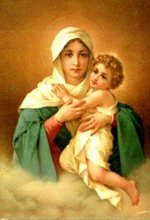
On then, my soul, on with head uplifted above earthly things, always satisfied
with God, with everything He does, or makes you do. Take good care not to
imprudently entertain a crowd of anxious reflexions which, like so many
trackless ways, carry our footsteps far and wide until we are hopelessly astray.
Let us go through that labyrinth of self-love by leaping over it, instead of
traversing its interminable windings.On, my soul, through despondency, illness,
aridity, uncertain tempers, weakness of disposition, snares of the devil and of
men; through suspicions, jealousies, evil imaginations and prejudices. Let us
soar like the eagle above all these clouds with eyes always fixed on the sun,
and on its ways, which represent our obligations. All this we must needs feel,
but we must, at the same time, remember that ours is not a life of mere
sentiment, and that it does not depend upon us either to feel, or to be callous.Let us live in the higher regions of the soul in which God and His will form
an eternity ever equal, ever the same, ever unchanging. In this dwelling
entirely spiritual, wherein the uncreated, immeasurable and ineffable holds the
soul at an infinite distance from all that is specific in shadows and created
atoms, it remains calm, even when the senses are tossed about by tempests. It
has become independent of the senses; their troubles and agitations and
innumerable vicissitudes no more affect it, than the clouds that obscure the sky
for a moment and then fade away, affect the sun.
Abortion is one of the things that some people even some churches are still confused about their evilnes. Fr. Corapi likes to say that the Devil's favorite color is not black as we usually think: It is gray!
The Devil confuses people. In all kinds of moral situation people don't know exactly if something is bad. If they feel that it arranges them, then they conclude that it must be okay since...this and that...even God can undestand this particular situation...etc.
The good thing about being Catholic is that our Church is not one of those ones who are confused about 'gray' issues. Dispite the largeness, or how many traditions, spiritualities, etc, the entire universal Church knows exactly what it wrong what is right in matters of morals and faiths. Jesus is with us. And He would never fail to answer you question cleary and to find a solution for it.
If you are confused about any matter you can be sure to get an answer. Here in the internet Catholic Answers' people can clear any doubt you may have.
On this blog, Theology of the Body, and Gospel of Life are themselves great moral resources left to us by our beloved pope John Paul II. They propose a deep and genuine undestanding of life, love, and truth based on the Bible, Reason and Faith .
An other kind of 'grey' area we often experience is about understandig the will of God at any moment of our lives. At work, and real life I always get confused on how to testify for truth without sounding judgemental, or feeling prideful.
There is a schoenstatt song we used to sing in Africa. It said:
" If Mother send you to (complete here with any charitable deed you can do for your neighbor)
Will you go right away?
Ans: Yes, I will go, of course I will go right away...
Now, some case are very easy. However, others are just 'grey'. You can feel her sending you, but you just can't figure out which way to proceed. Or, you are not well disposed to act. In either case, if something goes wrong later, you can really fell hurt. Mother sent you to her child and you failed her. You can fell the sadness. If this happened to you, this is one of the things you can do (you probably know others :)).
But it is bette to find avoid it from happening in the first place. We are told that we need to arm ourselves because the devil is always 'closer than we think'. The commandement of the King is to love. But love can be sometime very confusing. It is amazing how some acts that we may think are out of love may be precisely the opposite. From keeping silence out of 'respect' to a mother aborting her child because she is not ready (so it is good for both of them), all kind of acts and decisions may seem to be out of love. So how do we tell real love? How do we tell the reel will of God? and How do we find enough strength to do it?
In my previous post I provided links about "crashing the head of the Old Dragon". Remember that this dragon is mostly preocupied by our Mother and us who try to keep the commendements. Well, we are the strategic 'points'. We should always remember that we are in dangereous positions of the front. We are not in the occupied area, nor on the unoccupied area. We are on the frontline. Fr. Corapi has a great series on his web site about this spiritual warfare: Surrender is Not an Option. I think it is probably still running on EWTN (saturday and sundays).
Again this is the wonderfull document about Divine Providence. Read it and don't loose your blessings or miss to deliver God's blessings to others.
Tuesday, July 24, 2007
"In love lies true life" Fr. Kentenich

The french words translate: " You are a temple of life" His Holyness Pope Benedict XVI
Last night I had a very short but sweet dream where I got an unexpected wonderful smile. I wonder if it was because of this picture. I saw it yesterday and I had liked it very much.
Parce que l'Amour t'aime tu deviens amour
- Because Love loves you, you become love
Parce que l'Amour m'aime je deviens amour
- Because Love loves me, I become love
Thursday, July 19, 2007
Hospitality
Mother Teresa said that We can find God in two presance: The Eucharist, and our fellow neighbor.
Any visitor we get is the Lord and if we are not hospital we may miss a lot from him like Martha.
Taken from Sunday's reading, and explanation by Scott Hann from St. Paul Center.
Waiting on the Lord
Readings:
Genesis 18:1-10
Psalm 15:2-5
Colossians 1:24-28
Luke 10:38-42
God wants to dwell with each of us personally, intimately - as the mysterious guests once visited Abraham's tent, as Jesus once entered the home of Mary and Martha. By his hospitality in today's First Reading, Abraham shows us how we are to welcome the Lord into our lives. His selfless service of his divine guests (see Heb 13:1) stands in contrast to the portrait of Martha drawn in today's Gospel. Where Abraham is concerned only for the well-being of his guests, Martha speaks only of herself - "Do you not care that my sister has left me by myself...Tell her to help me." Jesus' gentle rebuke reminds us that we risk missing the divine in the mundane, that we can fall into the trap of believing that God somehow needs to be served by human hands (see Acts 17:25).Our Lord comes to us, not to be served but to serve (see Mt 20:28). He gave His life that we might know the one thing we need, the "better part" which is life in the fellowship of God. Jesus is the true Son promised today by Abraham's visitors (see Mt 1:1). In Him, God has made an everlasting covenant for all time, made us blessed descendants of Abraham (see Gen 17:19,21; Rom 4:16-17, 19-21). The Church now offers us this covenant, bringing to completion the word of God, the promise of His plan of salvation, what Paul calls "the mystery hidden for ages."As once He came to Abraham, Mary and Martha, Christ now comes to each of us in Word and Sacrament. As we sing in today's Psalm: He will make His dwelling with those who keep His Word and practice justice (see also Jn 14:23).If we do these things we will not be anxious or disturbed, will not have our Lord taken from us. We will wait on the Lord, who told Abraham and tells each of us: "I will surely return to you."
Friday, July 13, 2007
The meaning of "5"
I originally wrote a very longo post, I decided to remove some information which I will post under a different subject.
For a long time I have always believed that numbers have special meanings. The Bible clears shows use numbers such us 3, 6, 7, 10, 12 in a particularly loud way. Since it was on Friday that Jesus was cruxified, "5" seemed to indicate to me horror, pain, sorrow, etc. This belief was reinforced in my by what keeps happening in my personnal life. When I was 5, I lost my first little sister at birth, When I was 10, the war broke in Rwanda where I was born, the same war which culminated on the genocide. When I was 15, my parents divorced, and I ended up with two step-families. When I was 20 (that is the year 2000), I lost my family (mom, step-father, and three siblings) in a massacre. This event was particulary filled with 5s:
It was on Friday, five people died, and were buried after five days. Few months earlier I had joined schoenstatt, so I was trying to make sense of all of this in terms of divine providence. because of the state of their new 'marriage', my parents were not in communion with the Church. I remember seeing the in Church on Christmas or Easter and wondering how it must feel not to receive communion. But they were good people. They tought me to love people and everybody without distinction, which was a strange attitude in those countries of Great Lakes of Africa. It is this attitude which cause the massacre: We had refused to support an extremist side of a political party. Considering the status of my step-father, a highly educated doctor who had refused to go oversee for a better life, but chosen to remain with fellow countryman and help them, and his involvment in peacetalks that were working to restore peace in my country, we were considered worthy of extermination. But me and my little sister survived. Throught out the horrible event which lasted less than 10 min, we were praying the Jesus prayer.
But before I had prayed a novena to the divine mercy. When I prayed it, my first intentions where for other many people we had lost earlier, but for reason unknown to me I had decided to include '5' random people for my current living family for whenever God will chose to call them. I had found this novena from a friend at school, and it looked like a unusual treasure in wich I had to use to the maximum. God heard this prayer in all unexpected ways shown in little before and after the tragedy. But "5" still felt like an alarming signal for a sad event.
This discouraged me, because it made me think that at this signal tragedy was simply unavoidable. During 2005, I dismissed lots of divine providence signal to act. Always fearing that my action my provoke s0mehow a 'tragedy', I will only pray and say to myself that God is all powerfull. If I pray, God will give me clarity, and will see and do his will... which He gave. But because my prayers were not enough, doubts and fear overloaded my spirit. I should have thought of Jesus in the Garden of Getsemani and listened carefully to what he told the disciples. Here, Jesus prayed for his sacrifice for his Church, his Bride. When he prayed: " if thou wilt, remove this chalice from me: but yet not my will, but thine be done. " he indicated that this 'Friday' was not a day of horror and fear, but a day of sacrifice for love. Unfortunately, the weakness of disciples made it for themselves a day of sorrow and fear. We only need to read what happened next. The disciples became weak and fall asleep, when they woke up, they run away. Peter tried to stay with the Lord as far as his poor heart could allow him to. Out of fear, he cut the ear of one of the soldier, but that was not the Lord's way. Later, Peter denied Jesus three times.
How hard it must have been for Peter after he had denied Jesus. It can be hard to deny a friend, or more a dear friend, but how about God? Peter was the first to affirm the divinity of Christ. Plus imagine if God had shown you your destiny and in a matter of few hours, you destroy it yourself. Jesus, had told Peter that he was to be the foundation stone of his Church, his Bride. After denying Jesus, three times, Peter could very well be tempted to think with a quite high certainty that Jesus could not dare to trust such a person for such high business. But, Peter dared to hope that Jesus will forgive him. With his faith, he knew that God fix destiny once for all, from eternity. So, if Jesus had made a decision, nothing, no sin could prevent God's will to be done. He trusted Jesus, and later Jesus who is always faithfull kept his promise. Peter was made our first Pope. The faith of Peter is the faith of the Church and the faith of christians: The belief that God's Mercy is greater than any sin we can comit, the belief that the Church will last until the last day. The following verse show us that the only place where God's will is not done is outside of Eternity, outside of Reality (Jesus), that is in Past and/or Future.
But the angel said to me, "Why marvel? I will tell you the mystery of the woman, and of the beast with seven heads and ten horns that carries her. The beast that you saw was, and is not, and is to ascend from the bottomless pit and go to perdition; and the dwellers on earth whose names have not been written in the book of life from the foundation of the world, will marvel to behold the beast, because it was and is not and is to come."--Revelation 17:7-8
You can see that the Beast is not in the "Present", only in the Past and in the Future. We have to remember that this Beast is Satan, the Liar, the Accuser, the Murderer...from the Beginning. He destracts us from the present to behold the past (for remorse/pride of our deeds) or the future (in prideful ambitions or despair).
But Jesus who is Reality is in eternity. By his incarnation he brough eternity in time. "In Jesus Christ, the Word made flesh, time becomes a dimension of God, who is himself eternal. With the coming of Christ there begin "the last days" (cf. Heb. 1:2), the "last hour" (cf. 1 Jn. 2:18) and the time of the Church, which will last until the parousia. " As the Third Millennium Draws Near So that thrugh the 'narrow way' (way of Jesus) we can live in eternity while we are in time. We are written in the Book of life only when we love like Jesus. The "Beginning" means eternity because Jesus is himself "The Beginning" (the Alpha). Being written in the book of life means being connected and rooted in Jesus: Living in Jesus Christ.
Dispite the fact that disciples disapointed Jesus in his hardest time, they were only able to look in his eyes, and be confident enough to be his apostles, only after they had understood the mystery of death and resurrection. They accepted his eternal love in them. They started to see things as God sees them. They were not ashamed or proud of whatever their past was. Their past was sanctified and was used to radiate the Glory of God who is pure love and all powerfull.
For Peter, Good Friday was not longer a day of shame/horror/fear, but a day of God's love. God allows human weakness to show so that he can destroy it by the power of his love. Isn't the purpose of our live "to know, love, and serve God"? The purpose of our existance is to know what Love is. To know that Love is all that there is and that it is powerfull and nothing stands against it. To know the mystery of the Most Holy Trinity and that alone, it is worth our praise as long as we live.
It was on that same Good Friday that Jesus said that he was going to be in paradize with the 'good thief'. They were three crosses on calvary. To me they symbolize that whichever way we take in our life, we will always end up on a cross because our nature has fallen. All we can do is to chose which cross we have to end up with.
- The cross of Christ. Cross of innocent victims or heroic saints.
- The "good thief" cross is the ones of those who accept their guilt and offer up their cross to God in praise of his divine justice, but also his mercy: "Remember me when you are in Paradize".
- The "bad thief" cross is the ones of those who live through their suffering with curses. Who hide behind their pride, and sometimes end up in suicides like Juda.
Suffering is unavoidable. Between our world and the lost Paradize there is the cherubs of Genesis and their flaming swords. We can only go back to paradize by passing through these swords, that is through the right cross. We have to go through the nigh of death on the appropriate cross so we can wake up in paradize.
"Whoever does what I command, the Father will love him, and we will come in him and dwell in him" says our Lord. With Love we have the Trinity within us. We seek the Father's justice by offering the sacrifice of the Son, under the guidance of the Holy Spirit. On this Earth our lives are sacrifices. Christian life is a sacrifice. There may not be happyness, but there should always be joy.
But prayer is the first requirement in order to know the right sacrifice to offer. Many people suffer and they think they are sacrificing themselves for Love. But We have to remember Jesus in the Garden. Let's see again what happen in the Garden.
St. Luke:
22:39. And going out, he went, according to his custom, to the Mount of Olives. And his disciples also followed him.
22:40. And when he was come to the place, he said to them: Pray, lest ye enter into temptation. 22:41. And he was withdrawn away from them a stone's cast. And kneeling down, he prayed. 22:42. Saying: Father, if thou wilt, remove this chalice from me: but yet not my will, but thine be done.
22:43. And there appeared to him an angel from heaven, strengthening him. And being in an agony, he prayed the longer.
22:44. And his sweat became as drops of blood, trickling down upon the ground.
22:45. And when he rose up from prayer and was come to the disciples, he found them sleeping for sorrow.
22:46. And he said to them: Why sleep you? Arise: pray: lest you enter into temptation.
22:47. As he was yet speaking, behold a multitude; and he that was called Judas, one of the twelve, went before them and drew near to Jesus, for to kiss him.
22:48. And Jesus said to him: Judas, dost thou betray the Son of man with a kiss?
22:49. And they that were about him, seeing what would follow, said to him: Lord, shall we strike with the sword?
22:50. And one of them struck the servant of the high priest and cut off his right ear.
22:51. But Jesus answering, said: Suffer ye thus far. And when he had touched his ear, he healed him.
Jesus, prayed hardest and offered the perfect sacrifice
Peter prayed less and fell asleep, he fell into temptation and offered an unproper sacrifice
Juda was not even there he offered the worst sacrifice.
That is how prayer is proportional to the sacrifice we offer and what our "5" may mean for us.
Monday, May 28, 2007
Atheist gives $22.5 million for Catholic Fund
You can read the whole article here.
May 23 (Bloomberg) -- Philanthropist and retired hedge-fund manager Robert W.
Wilson said he is giving $22.5 million to the Archdiocese of New York to fund a
scholarship program for needy inner-city students attending Roman Catholic
schools.
Wilson, 80, said in a phone interview today that although he is an
atheist, he has no problem donating money to a fund linked to Catholic schools.
``Let's face it, without the Roman Catholic Church, there would be no
Western civilization,'' Wilson said. ``Shunning religious organizations would be
abhorrent. Keep in mind, I'm helping to pay tuition. The money isn't going
directly to the schools.''
Wilson's donation is the largest the archdiocese
has ever received. The money will be used to fund the Cardinal's Scholarship
Program, which was started in 2005 to give disadvantaged students attending the
archdiocese's inner-city schools partial or full tuition grants, Jacqueline
LoFaro, the archdiocese's associate superintendent of schools, said in a phone
interview today.
``It was a chance for a very modest amount of money to get
kids out of a lousy school system and into a good school system,'' Wilson said.
Saturday, May 19, 2007
Sharing Faith: So that our joy may be complete.
"We are writing you this that our joy may be complete" (1 Jn 1:4). The
revelation of the Gospel of life is given to us as a good to be shared with all
people: so that all men and women may have fellowship with us and with the
Trinity (cf. 1 Jn 1:3). Our own joy would not be complete if we failed to share
this Gospel with others but kept it only for ourselves.
The Gospel of life is not for believers alone: it is for everyone. The
issue of life and its defence and promotion is not a concern of Christians
alone. Although faith provides special light and strength, this question arises
in every human conscience which seeks the truth and which cares about the future
of humanity. Life certainly has a sacred and religious value, but in no way is
that value a concern only of believers. The value at stake is one which every
human being can grasp by the light of reason; thus it necessarily concerns
everyone." (Gospel of Life 101).
However, most often we seem to find good reasons not to share our Faith. At least I know that I have negleted it until recently. My reasons were similar to the following:
Actually I was trying to share my faith in a different way. I have discovered that, may be for melancholic people like me, the following quotes are most appropriate. We can somehow share our faith even though we are not perfect and we are sinners. Slowly, with Gods' help, we can learn how to apply them in our daily lives:
"Once and for all, a short rule is laid down for you: Love, and do what you
will. If you keep silence, do it out of love. If you cry out, do it out of love.
If you refrain from punishing, do it out of love.
Let the root of love be
within. From such a root nothing but good can come. " St. Augustine.
"Preach the Gospel, if necessary use words." attributed to St. Francis
These quotes can of course be misunderstood and/or misapplied. But the best way to understand them, is to check the lives of the saints who said them. It is obviously the best answer/attitude they found for the "eight reasons" of the guys in the video clip. As Fr. Corapi would say: " Learn your Faith". Yes, I am increasingly taking him seriously. After all we can't share what we don't have. Sometimes we don't really realise the consequences of negleting to learn our Faith. They can range from missing an opportunity to learn how to love and be virtuous, to being converted into a different system of belief (only to come back after we have learned our Faith, like it just happened to the president of Evangelical Society who just returned Home Rome (Roman Catholicism) - causing chock waves in the Sola System (Evangelical world) - ), or to falling into even really grave sin out of ignorace/despair (Lubben's testimony)
I have discovered that by learning more about our Faith, reading saints and converts stories, we can confirm ourselves in Faith and built more confidence in sharing it while we know that we are not perfect. St. John (was probably melancholic according to 4Marks Temperaments) also while telling us that he is sharing with us so that his joy may be full (1John 1:4), he also reminds us that he is a sinner and that he would be lying if he says that he is not a sinner. (1 Jhn 1:9), nevertheless, he feels that he have to share what he has witnessed (1 Jhn 1:1)
Friday, May 4, 2007
Videos in different languages
Welcome. I won't be writing too much in those language, but videos in those language will be indicated to google so they can reach you. If you don't see it when you visit this page, reflesh couple times and you should be able to enjoy few songs from Makoma, Kidumu, and other gospel, raggae, or other good songs from Africa, india, etc.
Thanks for people who provide those songs to youtube.
God bless